About Me

My photo
Lawyer, traveller, musician. Not sure if that's the proper order though.

Sunday, January 10, 2016

The Bhutan Narrative

I do not know whether you find or lose yourself in Bhutan. The sounds you most often hear are the rustle of the leaves, the gurgling of the river, the slow rhythmic chants of the monks on the monasteries on the hill, and the song that plays in your head.


Paro airport welcomes you with the embrace of mountains around you. That's the first sight that you see on disembarking. That, and the ever-smiling tomato-coloured  faces of the Bhutanese children.

Paro is just almost as big as my college campus. There's a single main street, and small distributaries jutting out, containing the markets and the humble hotels. There are bridges under which the river flows. At the cost of sounding poetic, the mountains smile from a distance, sometimes revealing their snow caps. The shops are few, and portray a middle class contentment.

If you cross the bridge and walk a little further, you come across an old temple. They say it's 1200 years old. It may be less. It preserves the faith of the people in religion.

Paro itself sleeps by 9 p.m. Sleep comes early in the mountains. Perhaps it's because there is nothing much to do otherwise. But there is no sense of urgency. Everybody helps you, and people go about their own work which would give the illusory impression that they are busy (even if they are not occupied).

Never have I seen the people of a place so content with their life. They seem to want no development. They are happy living in the hills, in the small hamlet they call their town.

- May 09, 2015.


It was a clear day. The journey to the Chelela pass provided so many beautiful images that I wouldn't have minded if the destination were a little disappointing. It is even a great experience to stop the car and take a leak at a random corner in the hills. It's not often that the bathroom promises such freshness in the air you inhale.

We reached Chelela pass, and the mountains shone with all their magnificence. The snow capped peaks afar were as beautiful and unreachable as the happy memories of a long-lost love story.

During the descent, our driver very innocuously asked us if India has a king. He was very disappointed when we said it didn't. He was of the firm belief, like the rest of his countrymen, that the presence of the king prevents crime. How can India, being such a big country, not have one?

I broke my travelmate's glasses while attempting to take a photograph. The problem has been temporarily resolved though. Paro has two optical shops. The kinds you found twenty years ago in a small Indian town.

- May 10, 2015


Tiger's Nest is said to be the main attraction here, and the biggest tourist draw. It is not a difficult trek really, but it's rather long. The trek ends at the monastery, which is the site where Guru Rinpoche is said to have reached on the back of a tiger and meditated. 

Throughout the journey, I kept wondering as to why the Guru could not choose a more convenient place to meditate. But just when I reached the monastery, after a lot of huffing and puffing, I felt I knew the answer. You can see a waterfall from the monastery, probably flowing into the Paro river. The monastery, jutting out of the hill, overlooks the valley. There are two sounds - one of the tourists in their various languages, the other of the monks in their prayer language. Both would have been absent 1200 years ago. The place would have been eerily deserted. I guess the wise man can find salvation only in such quietude.

During our descent, we were the only people around. And then, I could only hear the rustle of the leaves. For the entire journey downward. I would stop at various intervals to take in the feeling. I had never felt tranquility from so close in my life. For an antisocial like me, it seemed a perfect place to set up a house. I kept looking at the monastery from below to visualize what it must have been for a man all those years ago to come and meditate here. Scary? Difficult? Serene? All of these? What was it that was revealed? Someday I wish to return here, or go to somewhere similar in search of peace. Till then, I shall keep traveling.

It had started raining and I had to see the Drukgyel Dzong, a 14th century ruined fortress. Drukgyel, I am told, means "Victory of the Druk". With the Dzong being absolutely run down, with not a soul in sight except me and no sound except the pitter patter of the raindrops, the place seemed haunted. I cannot write more here, since I am always scared of such places, and their memories. But notwithstanding all that, it is an experience which I recommend everyone should have, and if possible, in a way similar to mine.

- May 11, 2015.
Drukgyel Dzong - The ruined fortress

Thimphu, the capital, is an obvious way markedly different from the other places. To begin with, it is much larger than Paro, and a large part of the valley has been cleared of the vegetation to accommodate all the important administrative and commercial centres. Unlike Paro, which can be exhausted on foot, Thimphu has avenues, one ways and all such things befitting a capital city. However, the essential culture is retained in the architecture.

A good vantage point to see the valley is the Changangkha Lakhang. Sit on one of the benches and look down, breathing in the city. Drive across to Buddha Point, which is still under construction, where the huge statue of the Buddha looks over the city. Did you say Rio? There's something really serene and calm about the smile of the statue, which in turn lends a certain calmness to the entire atmosphere. Make a visit to the Memorial Chorten. It is the biggest Chorten in Bhutan; the queen mother built it in memory of her deceased sun. The square is surrounded by hills, and it is worth a visit.

The Takin is the national animal of the country. It is a harmless herbivore, with the appearance of a cross breed between a hippopotamus and a goat! The Yadkin reserve offers you the opportunity to say hello to the Takin.

Roam around Thimphu for the shopping; there are numerous shops lined along the main market area selling touristy paraphernalia. Make sure you bargain. Try exploring the city by walking around the main market area. Have momos at Zambala café. You’re lucky if you get a table by the window at the Ambient café; that’s another recommendation.

-          May 12, 2015


The Tiger’s Nest to be trekked at Paro has become the most popular sight in Bhutan due to its magnificent views. From Thimphu, there are similar treks to monasteries on the hills. They are often way lesser traversed than Tiger’s Nest. Treks to the Tango and Chagri (or Cheri) monasteries offer the same quietude (perhaps even more), the same dried-leaves-on-the-way trek, with the additional sound of the gurgling of the river. Tango and Cheri are located on two separate hills, though they are close by. Which means one has to trek twice. However, the trek is easier and shorter than Takhtsang.

While I was descending from the trek, Pema, our driver, suggested that we play a game of ‘Khuru’ by the river. It is a primitive version of the dart, with the aim being a piece of wood, and the prize being a piece of cloth to the winner. After the game, I stopped by the Wang Chhu river, just to sit on one of the rocks by the river and see it flow by. It felt like I had stopped there for an eternity, just to gaze at the river and the forests surrounding it like a protective parent.

The evening was spent walking around Thimphu. But I would recommend you to go to Taj Tashi for dinner. Believe me, it’s not a snobbish suggestion. If you wish to have good, authentic Bhutanese food at reasonable prices (Rs. 1,800 all inclusive for two), try Taj Tashi. And yes, they haven't paid me to write this here.

Make sure you drill it into the mind of your hotel manager that you will be late if you will be later than 9:30 p.m. in the evening, er, at night. Everything shuts, including your hotel, so make sure your manager has really understood you. I don’t wish you to have the same experience as I did. You don’t want to be banging your fists on the shutters, crying, “Hello, hello, hello. Is there anybody in there?”

-          May 13, 2015


It takes more than four hours to reach Punakha from Thimphu. Unlike other occasions, the route this time is not particularly pleasing to the eyes. There’s congestion, dust, repair work – all things that are offshoots of landslides primarily. Fantasies apart, the hills are not so easy to live in.

Our first stop on the way is the Dochula Pass. Hidden in the morning clouds are a hundred and eight Chortens. As one climbs up, there’s a panoramic view of the mountains. I knew we were getting late and there was quite some way to be covered, but I guess for some time I let such thoughts be. What is a vacation after all, if we follow routine? It was just nice to sit on the grass amidst the innumerable chortens, watching the clouds swaying above in agreement with my happiness.

We carried on to Punakha district, and stopped next at the Chimi Lakhang. The Lakhang is a popular religious reference point here in Bhutan. Chimi Lakhang is the fertility temple, consecrated in honour of the ‘Divine Madman’, who blessed couples with boons of fertility so that they could beget children. That the temple is the fertility temple is made a bit in-your-face obvious with images and structures of erect penises all over. This I suppose is the symbol of fertility. (Somehow, the penis seems to be quite an important symbol in another religion too). Pema says he too was blessed with his son after a visit here, and he comes every year with his family now. His son was named Kile Rabge, as the priest here told him to. Kile will turn three this year, and he loves cheese.

The Jacaranda tree flowers around this season in Punakha, and so all around the Lakhang, I saw purple spring flowers. This view was slighted by more imposing views of the purple-blue Jacaranda flowers at the Punakha Dzong a little later.

The Punakha Dzong is situated on the confluence of the Mother River (“Mo Chhu”) and the Father River (“Po Chhu”); the identification being of the father being fairer (no pun intended) than the mother. The fairer river being male is no coincidence – Bhutan is inherently a patriarchal country. 

One enters the Dzong through the cantilever bridge overlooking the rivers, surrounded by hills. To enter the Dzong, which is one of the largest in Bhutan (and clearly the most impressive), you need to pass through the garden of Jacaranda trees, and the crowd of tourist-photographers. Inside there are huge temples dedicated to the many Buddhas and Bodhisattwas (Oh yeah!). There are administrative centers, hostels for monks, more temples. And there’s quietude.

We headed to our hotel – Punatshangchhu Cottages. I don’t think I’ve ever been so happy on seeing a hotel room. But I have never before seen a room which overlooks the river, with the hills in the background, and the town that can be seen in the distance. I could open the broad window to step out of the room into the grass, which goes down to meet the river.

I’ve always had this dream of spending my life alone in a valley, overlooking the river, with the hills in the distance and civilization at a week’s length – I continue to have it. For this one evening, I get to live the dream. I read a few lines from my book but mostly stared outside. The urge to live a life in such a place grew stronger. I wish to grow old and die somewhere here, alone in a valley, overlooking the river, with the hills in the distance and civilization at a week’s length.

We were having dinner and there was a group of Maharashtrian tourists, led by their tour operators, Kesari. The tour operator had promised its clients ‘Aamras’ in Bhutan – there was aamras for dinner. I’m told their USP is providing Maharashtrian Poha to their clients under the Eiffel Tower. Depressed, I head back to my room to see the view once again, to take in a sight that will last me a lifetime, even if my dream doesn’t ultimately fructify.

-          May 14, 2015


It is in every sense a village, this place where I am staying today. Somewhere close to the Phobjikha valley. A small road leads to the cottage where we are to stay. Alongside the road there are a few small shops selling biscuits and chips. They cannot believe it that I bought junk food worth a hundred rupees – didn’t want to take chances.

My room on the second storey has the most basic look. It has wooden walls and a window that offers a view of the valley. The only meat available in this place is beef; thankfully I am not religious. There is a run-down Dzong just opposite the cottage. Very basic again, nothing impressive. But I’m told that this is the place where the young monks are trained. Despite the rustic look, there is something attractively simple about this place.

I have nothing much to write about the day. Except that I perhaps needed it. Away from all the touring, hidden away in a silent corner, watching the night descend quietly on the countryside. I guess sometimes one even needs a break from travelling while travelling.

-          May 15, 2015


The only thing on our agenda today was a ride to the Phobjikha valley. As we descended down to the plain land from the U-shaped valley, it offered a panoramic image, with violets (viola? What are those plants called?) on the ground. Lots and lots and lots of them. There are small brooks flowing along the narrow, winding road.

Pema got a log from somewhere, and within seconds he was ready with a Khuru dartboard. So the violet valley became our playground, with the brooks and flowers next to us, and the hills and a Dzong in the distance.

On our way back we stopped at the U-shaped valley. For another round of khuru. The Buddhist flags fluttered away, and there was the river below, and the hills afar. I had the ground to me – to build another imaginary house on.

Not finding lunch anywhere else, we returned to our cottage. The rest of the day was just spent reading Gabriel García Márquez’s short stories, and staring out on to the valley from my room. I tried some ‘Ara’ at dinner – the local drink here. They cautioned me against consuming too much, since it was apparently too strong. Nonsense!

-          May 16, 2015


Post-Script


Sunday, June 14, 2015

The Spanish Travelogue 5: Madrid - The So(u)l of Spain

The Spanish Travelogue chronicles my journey through the explored and unexplored regions of the Spanish mainland (and the unexplored corners of the explored regions).


The rest of the country takes its afternoon Siesta. Madrid doesn't even sleep at night. Madrid is the big city where you can lose yourself, amidst the wide roads, the huge buildings and the vast Madrid population busy losing itself amidst the wide roads, the huge buildings....


I will begin with a wikipedia-esque introduction. Madrid is the capital and largest city of Spain. And Madrid makes one feels its enormity through not just the wide roads or the palatial buildings; the enormity is in the spirit of the city. Madrid is the kind of city you will want to get lost in - amidst the hordes of people walking on the wide side-walks, passing through the bustling squares, past the shops selling knick-knacks, the art museums containing various visions and more. Madrid makes you feel as alive as it itself is. 

Though geographically speaking, Madrid is a big city, all the attractions are situated quite close to each other. The easiest ways of commuting are by metro and by foot. It is advisable to take a day-pass for Zone 1, which makes you travel to all places there are to see in Madrid, except the football stadium. Get off at the convenient metro stations and walk on the boulevards of Madrid to reach your destination. 

The most popular meeting point in Madrid is the Puerta del Sol. The place is always abuzz with people going somewhere, coming from somewhere, just standing, playing music, making love (up to a certain base), protesting for human rights, every kind of activity. Take the metro to Vodafone Sol, and walk up to the point where there's a statue of a bear hugging a tree. This.


The bear above is the starting point of the Gran Via. We shall come to this in a while. But for now, take the opposite direction and head towards the Palacio Real (or the Royal Palace). A view of the grandiose palace from outside should suffice, unless you're one of those tourists who think everything should be covered. 


The Madrid Cathedral is adjacent to the Palace. Again, I would recommend that seeing the Cathedral from outside should do. 


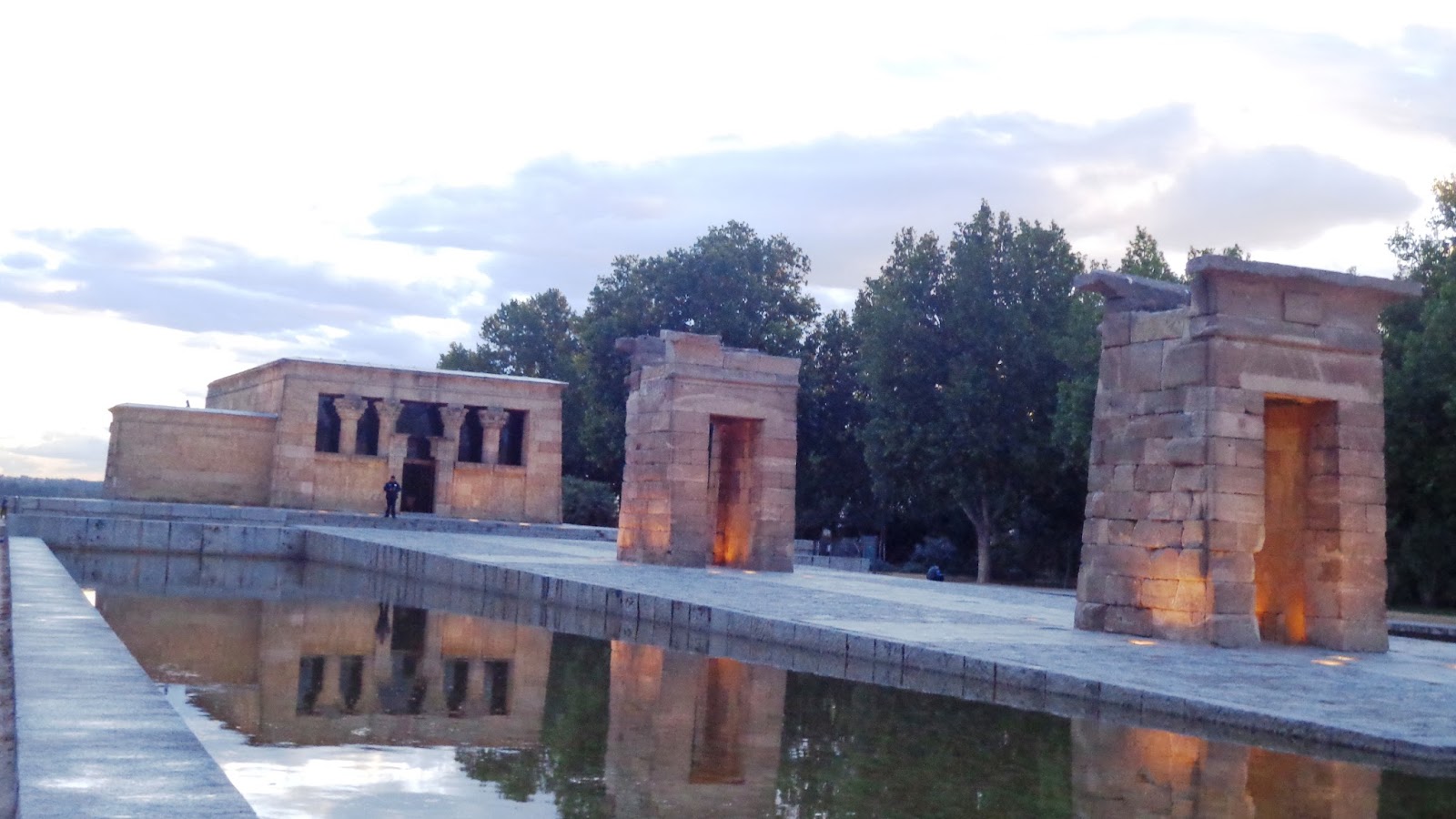
From the Palacio Real, walk on to the Temple of Debod. An ancient Egyptian temple, the Temple of Debod was dismantled and rebuilt in Madrid. I would recommend visiting the Temple at sunset for breathtaking views of the Palacio Real and the city. 


Walk back to the Gran Via. If you are tired after all the walking (your author is always tired and hungry), take a small detour to visit the Plaza Mayor. As you sit at a cafeteria inside Madrid's central plaza to have your tapa and coffee (or your choice of drink), look around you. What seems today to be just an imposing square surrounded by residential buildings and teeming with cafeterias, used to be at one point of time a famous centre for bullfights and public executions. 


The Plaza has another interesting story about it. The statue inside the Plaza is that of King Philip the Third, mounted on a horse. The citizens of Madrid had once thought of building an underground parking lot, and thought it fit to temporarily remove the statue. Upon doing so, they discovered that the statue was hollow and was filled with dead sparrows, which had entered through the mouth of the horse and could not find their way out again. The citizens then thought it appropriate to seal the mouth of the horse so that no more sparrows would be trapped inside the King.


If you are still hungry (despite reading about these stories), walk a little from the Plaza to Sobrino de Botín, the oldest functional restaurant in the world. In fact, I'd say even if you aren't that hungry, do a bit of a pilgrimage by walking across to the restaurant established in 1725, where even Francisco de Goya worked as a waiter! (Okay this was BEFORE he was inducted into the Royal Academy of Fine Arts). And don't let Mr. Woody Allen convince you that you only come across Ernest Hemingway and Scott Fitzgerald in the Parisian midnights of the '20s; both of them have spent many an evening here, in Sobrino de Botín. (Hemingway preferred to be referred to as 'Ernesto' in Spain. Just by-the-way-trivia).


Now that the hunger is quenched, let us digest it by walking across to the Gran Via. Which reminds me. My suggestions to readers wanting to travel to European cities is, Always try to take a walking tour. That suggestion continues. 

Moving on, once you reach Sol and find the bear, walk on towards the Gran Via. Gran Via in Español means, "Grand View". True to its name, The Gran Via is the broadway of Madrid. The convergence of many streets lends it a grand view, and you should just take the evening stroll on this road to see the colours of Madrid come alive. The Gran Via is the go-to place for nightclubs, fine dining and shopping, if you have the money to splurge. Though I won't expound on this much, the debauchery dens are located close by, if you stick on till late. Go figure that bit out yourself. 


If you are walking along the Gran Via during the day, walk on till you reach the Plaza de Cibeles. Go inside, take the elevator, reach the top, admire the view of the square, take a photograph. Descend. There's nothing else to see there.


We next go to the Puerta de Alcalá. Located in the Plaza de la Independencia, or the Independence Square, the monument is a pleasant place to stand and stare, or be clicked. 


A couple of minutes away from the Puerta de Alcalá is the Retiro Park. Initially belonging to the Monarchy, the park is now open to the public. The park is surrounded by monuments and sculptures built in the Gothic style, that surround the lake in the centre. I would recommend lunch at  the eateries here. Thin-crust pizza and Sangria. 


Needless to say, Madrid has a bustling night life. The most popular night club here is the Kapital. Get off at Atocha station and walk on till you see Madrid's young population clustered around the seven-storey club. Make sure you find out about the dress code. If you find Kapital expensive (which it is, especially on Friday nights), you might hit the Velvet Disco, which has really amazing music, and a great crowd. 

I had kept the topic of museums for the end. Simply because museums are a matter of personal choice, and how much of time you would devote to visiting them depends on how much of a sucker for art you are. If so, then visit the museums in Madrid, and (firstly) read on.

Madrid is the art capital of the world. Of the twenty-odd museums, which you won't have time to visit unless you are staying in Madrid for a long duration, you must at least visit the Golden Triangle of Art - The Prado, Museo Reina Sofia and Thyssen-Bornemisza. I would suggest you visit in the aforesaid order of priority.

The sheer number of rooms containing paintings segregated according to time periods and countries makes it impossible to cover Museo del Prado in a day. Which is why it is advisable to spread your Prado visit over two or more days. Entry to the museum is free from 6-8 p.m. on Tuesdays to Saturdays. Reach the museum well in advance in order to avoid a huge line in front of you. If you are running short of time, make sure you don't miss out on the works of Velázquez, El Greco, Titian and Rubens. A personal favourite was the room displaying Venetian paintings during the 16th century.


The Museo Reina Sofia has a bigger name, but that's not important. What is important is that you do not miss the surrealist paintings. The connection demonstrated between the works of Dalí and Buñuel is a must-see, and so are the works of Picasso, Juan Miró, Juan Gris, Pablo Gargallo and Julio González. I didn't understand abstract expressionism and Neo-Dada though. 


The painting above is that of a Musician's Room. One of  the best depictions I have seen.
A baron and his wife were curators of art, and courtesy their cultivation of the interest, the Thyssen-Bornemisza now houses some of the rarest paintings and art works from across centuries and cultures. Thyssen is the third on the priority list of museums, but the art lover would just find it so much worth spending time roaming around the various rooms of the museum. Madrid is perhaps as much beautiful from within as it is from without.


Post Script:

It was my last day in Madrid (and also in Spain). I had gone to the Plaza Mayor for dinner after a day of Prado and Thyssen, and was sitting at one of the cafeterias. The server, Luis, overheard me speaking in Bengali with my friend and started chatting up. He even tried to greet me "Nomoshkaar" in Bengali, which got me curious. Luis then told me that his elder brother takes a road trip from Spain to India every year, to conduct business! I had ordered a vodka, and Luis kept pouring till it seemed to me that he'd poured about four pegs of Absolut Vodka. I mildly protested saying I will far overshoot my budget with this, to which he said, "You only pay for the one drink you'd ordered; I always pour a little extra." Luis winked, smiled and went away.

Saturday, March 7, 2015

The Spanish Travelogue 4: Sevilla - Spain's Sunny Side Up

The Spanish Travelogue chronicles my journey through the explored and unexplored regions of the Spanish mainland (and the unexplored corners of the explored regions).

If you have ever wanted to go to Spain to see colours, to walk around the streets and bask in the sunshine, to witness bullfighting, to watch a flamenco dance or to do the Tango, you've probably been inspired by Sevilla. 

To start with the basics, the pronunciation is Seviya. Sevilla, or Seville, is the largest city in the autonomous province of Andalucia. But unlike its Andalucian counterpart Granada, Sevilla retains more of a Spanish flavour in a confluence of Spanish and Arabic cultures. 

Unlike the unpredictable weather in The Basque Region, Sevilla's climate is more stable. You won't be hindered in your expedition by that sudden incessant rain, and you can have your shades on. Whatever there is to see in Sevilla can be covered in a day by walking around the city. 


It is a good idea to make the most famous meeting point in Sevilla your starting point - the twin structures of the Cathedral and the Giralda. The Cathedral of St. Mary was built after the Reconquista, the re-conquering by the Christian kings of the Al-Andalus region from the Moors. The Sevilla Cathedral is the largest Gothic cathedral in the world. The Cathedral stands on what was the former site of the city's mosque, and was built over a hundred years after the Reconquista. It is a World Heritage Site today. 

The Sevilla Cathedral is the largest Gothic Cathedral in the world. 
I must say that I did not find the interiors of the Cathedral having any awe-inspiring ability, unlike that of the Notre Dame in Paris. Perhaps the only attraction was the catafalque of Christopher Columbus. 

The Catafalque of Christopher Columbus inside the Sevilla Cathedral
I suggest you walk on, to what I think is the more picturesque attraction - La Giralda, the bell tower of the Sevilla Cathedral. 

La Giralda - The most important landmark of the city
The entrance to La Giralda is from inside the Sevilla Cathedral. La Giralda is a much older structure, and was built during the Moorish period as a minaret. After the Reconquista, the city's mosque was converted into a church, and the bell tower is therefore an instance of an architectural blend of the two styles. 

As you take the winding path leading to the top of the Giralda, you come across various drawings and instruments from that period which have been preserved in the bell tower. Keep a watch for them as you climb along.

The view of the Sevilla Cathedral as you walk up the Giralda Tower
Before coming to Sevilla, I had seen photos of the city and there was one photograph that was a recurrent. It was of an aerial view of a square, a view of a clear sky and of houses with bright colours splattered across the city. While climbing up the Giralda tower, I saw the photograph come alive in front of my eyes. It was this. 


Walk on from the square of the Cathedral towards the riverside. You will reach the bridge of Isabel II, known more popularly as the Triana bridge or Puente de Triana. This is because on the other side of the river is the neighbourhood of Triana. The bridge, hanging over the Guadalquivir river, separates the main city of Sevilla from the neighbourhood of Triana, and both sides maintain their distinctiveness in character even to this day I'm told.

Puente de Triana
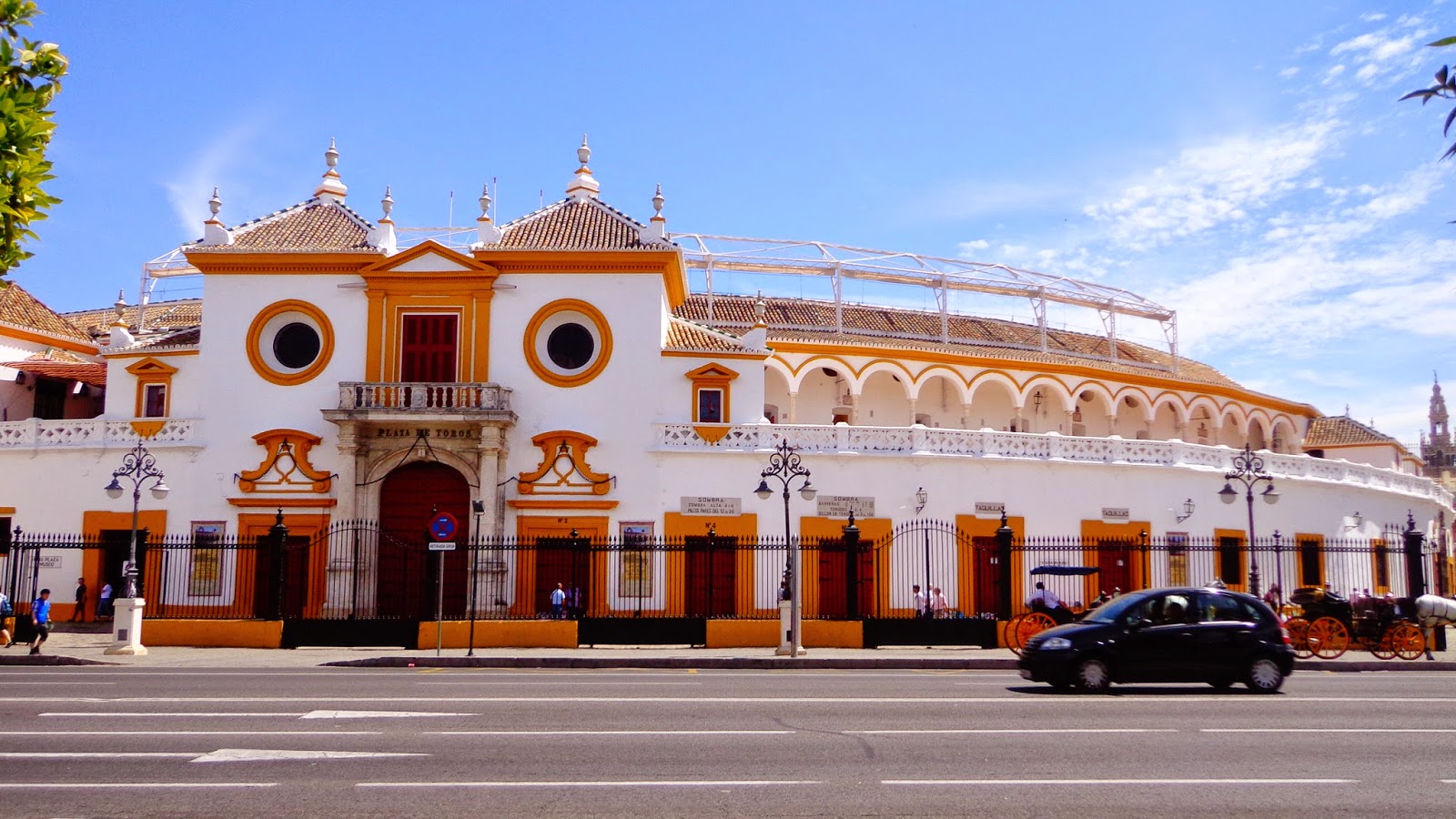
Keep walking along the river bank on the city's side, and you will see Plaza de Toros to your left. Plaza de Toros is the location of the bullfighting museum, and is open only on days when such fights take place. I wasn't lucky enough to venture inside. I am told that traditionally, the king would appear at the entrance and signal for the game to begin, and only then would the gates be opened. Sevilla has such tales in every nook and corner; you only have to keep your ears out for them. We will move on to another. 

Entrance of the Plaza de Toros -  Bulls fight within.
Walking further on, you reach the Torre del Oro, which translated to English means 'Gold Tower'. It served as a watchtower for the Almohad dynasty, and a prison during the middle ages. It was used by King Pedro I to hide his treasures of gold and silver, and a woman he loved - Aldonza Coronel. Folklore has it that the enchanted king had imprisoned the woman whose love he could never get. Apparently she poured burning oil over herself in protest. Sevillian stories float about like the breeze, and there is no way to test their veracity. They are however as colourful as the houses.

Torre del Oro
You can revisit the riverside in the evening, since the dance performances usually happen around this side. And when in Sevilla, you have to watch Flamenco! Andalucia is where Flamenco was born, and Sevilla promises the best performances that you would see. The music is again a fine blend of Spanish and Arabic influences, as the architecture in Sevilla is. I would however suggest that it is better to catch a performance in smaller cafés, instead of extremely high-end commercialized performances designed to cater to the tourist. 

It is a better idea to catch Flamenco shows in the smaller cafés
Now we come to the other crucial aspect - food. Personally speaking, I have not had better food in Spain than in Sevilla. You come across narrow streets lined with cafés which serve the most delicious tapas. Only try tapas, so that you can walk on and experiment and eat more. Food in Sevilla is not really expensive, so it doesn't pinch the pocket even if you go on an eating overdrive. A personal recommendation is Café Eslava, which is on Calle Eslava. The squid cigaro here is.... Indescribably delicious, so you have to taste it for yourself. And I hope you get a chance to do so.  


Post Script:

Another Sevillian story. The official motto of Sevilla is a symbol - No8Do. The term stands for the Spanish "No me ha dejado", meaning "It has not abandoned me". Legend has it that when the son of King Alfonso X, Sancho IV tried to usurp him from his throne, the King took refuge in Sevilla, whose citizens refused to hand the old King over to his son. This title was given to Sevilla by the king as a mark of appreciation, and appears as a motif at many places in Sevilla. Perhaps I would be fair to say that Sevilla never abandons anyone who comes here; it stays on with the person long after he's gone. 


Sunday, December 28, 2014

The Spanish Travelogue 3: Granada

The Spanish Travelogue chronicles my journey through the explored and unexplored regions of the Spanish mainland (and the unexplored corners of the explored regions).


If you are fond of cobbled streets, acoustic music, sunny weather and fusion food, Granada would probably become your favourite Spanish city. The confluence of Arabic and Spanish cultures, Granada is located in the province of Andalucia, at the foothills of the Sierra Nevada Mountains. The Mediterranean has an influence on both the climate and cuisine of Granada. 


Exploring Granada invariably requires you to know a bit of history (don’t worry - I will keep this bit to a minimum). That is because the main tourist attraction in Granada, drawing thousands of tourists from all over the world, is the Alhambra palace, the blend of Muslim and Christian histories and architecture.


The Umayyad conquest of Hispania in the 8th century A.D. established the Moorish control over the region which broadly comprises the present province of Andalucia. And therefore, it is not surprising that the epistemological origins of the word Granada find root in the Arabic Ġarnāṭah, which I was told loosely means ‘Hill of Strangers’. Now that’s a convenient name the Arabs used to explain their evident feelings about a completely different culture they witnessed when they established their rule here in the 8th century.

In the 13th century A.D., the Muslim Nasrid dynasty ruling over Granada prospered despite the Christian Reconquista by Ferdinand III of Castile. The region of Sevilla had already been taken over by the Christian king by this time, and Granada remained the central refuge of the Arabs in the Al-Andalus province. It took more than two centuries thereafter for the Christian kings to take over the complete control of Granada, thus marking the end of the Reconquista.

The Moors (loosely meaning, Muslims of Arabic descent) staying on in Granada were eventually forced to convert to Christianity, and over the years they came to become a separate ethnic group called the Moriscos.

The Alhambra palace, with a towering view of the entire city, evidences various periods of the history of Granada. The castle of Alhambra dates back to the 12th century A.D., and consists of several zones, eminently, the Alcazaba (for purposes of defence), the Nasrid palaces and El Generalife. While most of the Moorish and Morisco architecture has been preserved, there have evidently been later Christian architectural interpolations. Views of the city from various quarters of the palace are beautiful, and if you are into both history and photography, then you ought to visit the palace with a lot of time on your hands. The Court of Lions and the fountain, and the Hall of the Ambassadors are prime attractions. 

The Alhambra offers a towering view of the city, with the Sierra Nevada Mountains in the distance

The Court of Lions at the Alhambra
El Generalife, adjacent to the palace, was the garden of the Nasrid kings

El Patio de la Acequia, or the Water Channel Courtyard, is an example of a medieval Persian garden

A special mention needs to be made here of the Hall of the Abencerrajes, with the roof bearing the honeycomb design, as can be seen in Gaudí’s works in Barcelona. Folklore has it that the last Sultan of Granada invited the chiefs of the line of Abencerrajes and massacred them in this hall. Palaces do have small histories hidden in their nooks and corners! I must say that I found the Generalife, or the palace gardens, a bit overhyped. I did not tour the palace at night, but it is said that the nightlife from the Alhambra is worth a visit. You could visit the Granada cathedral and the Royal Chapel which were superimposed over the Great Mosque of Granada, as it existed then.

The honeycomb design in the Hall of the Abencerrajes at Alhambra 
The Christian structures are a superimposition on the Muslim ones

A quick tip here: Book the tickets for Alhambra well in advance. The palace authorities have to invariably be a little inflexible about time, due to the heavy influx of tourists. It is therefore advisable to reach the entrance well on time to avoid hassles.

Moving on from the Alhambra, visit the Albayzín area of Granada. On the right bank of the river Darro, the Albayzín is the ancient Moorish quarter of the Granada. Having the best views of the Alhambra, the Albayzín has cobbled streets opening on to the main street, lined with cafeterias. Albayzín is also the popular shopping district of Granada, so make sure you bargain very well and do a lot of window shopping in order to get the best deals. This I write from impression and not from experience, since I spent most of my time around this region in the pursuit of food.

The Albayzín area has cobbled streets opening on to the main street, lined with cafeterias with the Alhambra towering above

If you have been roaming around other places in Spain and are tired (alright, blasphemously tired) of Spanish food, Granada offers you relief-restaurants, with an abundance of options in Arabian and Mediterranean cuisine. The beef couscous with caramelized onions is a personal recommendation. A lot of restaurants offer fusion food which is worth exploring.

Granada is a place you explore by just walking around. Your walk may take you to El Realejo, or the Jewish quarters. The cobbled alleys, the quiet walk by the river at night with the imposing Alhambra palace as the background, the musicians at every corner with their guitars, cajons and accordions, all add to the charm of the city. On one particular evening when a football match was on, it seemed like the entire city had poured out into the streets to watch the game from the cafés, and the enthusiasm in the celebrations was contagious.

Post Script:

It was a lazy, sunny day and I was sitting drinking Raki in one of those numerous open air cafeterias in the Albayzín area which have the Alhambra overlooking them. From the band of musicians playing nearby, the accordion player suddenly came up to me, smiled and said, “Raj Kapoor?”